

The more you know someone, the harder it becomes not to love them. And there’s a hard limit on how many people you can love: five.
What we call openness and vulnerability is a function of shared time and shared secrets. Every conversation helps you understand a little more of who they are. Little intimacies exchange minds. They tell you how they see you, and you feel seen.
It’s not just romantic love. It happens with family and friends. Your siblings are childhood strangers until you give each other the opportunity to meet the person you actually are. Your friends are just people you happened to see periodically, until you know each other’s worries and joys in a way no one else does.
For others to love you, they need to see who you really are.
Of course, this is the internet, home to the normal distribution curve of humanity. A beautiful 15% of our best humans coexist with the foaming, psychopathic worst 15%, who will destroy you if you disclose your vulnerabilities to them. All of it padded by the safe, mid, 70% of the bell curve.
Do not do this on the internet.
I love to love. It’s a powerful side effect of the relentless intellectual curiosity that guides my life. I want to know everything about everything. This quirk has served me incredibly well and is at least 33% responsible for all the good things that have happened to me.
However, to love someone is to subscribe to their pain. So I can’t love everyone.
My network of friends is an unwoven mess of pulled threads, cruelly distributed around the globe. The people I admire the most, and who know me best, live in different cities, across different continents, separated by ten-hour flights and unfair time zones.
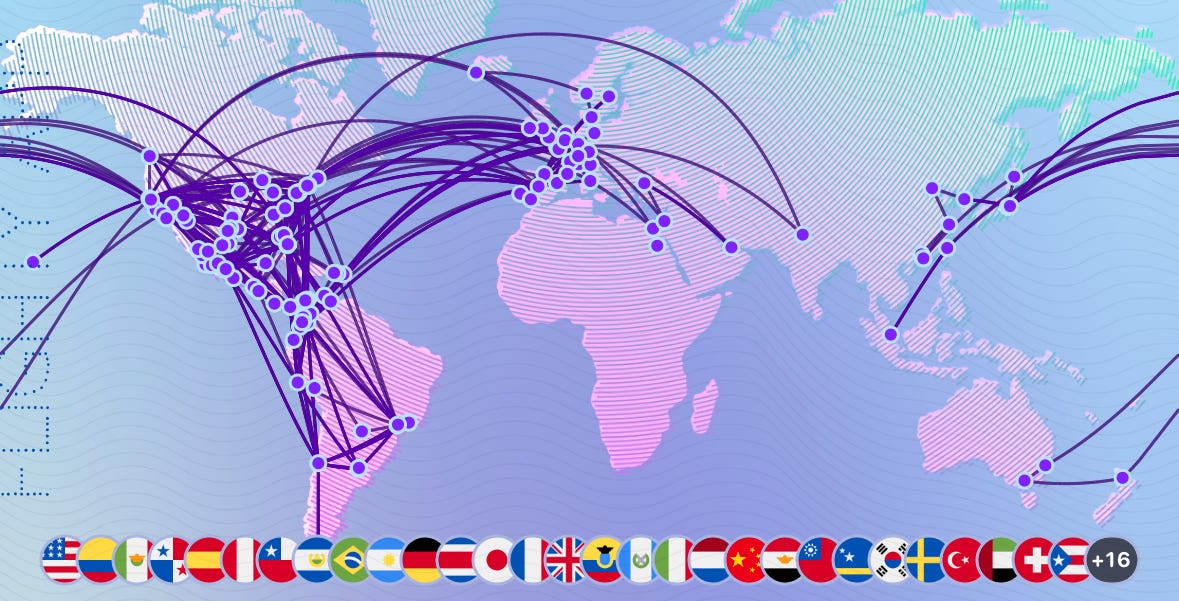
I built these relationships across my 30s by flying a lot. High-intensity trips of deep understanding and connection, living two-day journeys as fully as we could. I never ask “how are you?” and I can’t do small talk. Every question I asked had meaning, and every answer I gave was consciously crafted.
To feel seen is an addictive feeling, and it has to be earned.
I’m 39, so I’m still young, but old enough to see this cycle degrade. Some people fall into black holes of self-harm or mediocrity which, once you see them, will hurt you. Some, separated by distance, become different people who still carry in their memories the truths you shared. When things go wrong, some of them will use those truths to hurt you. Or you may hurt them.
Most, however, will just fade.
As you grow older, you naturally prioritize the relationships connected to your home, weakening the rest. It doesn’t matter if you’re monogamous, religious, poly, nomadic, slutty, or whatever. At the end of the day, you sleep in the same house, with the same people, for most of the year.
You have 24 hours in a day and 12 months in a year. You will filter people out of your life out of joy, conviction, duty, or routine.
Robin Dunbar is a science guy who measured, quite precisely, how many people you can actually know, and how much time you should dedicate to them:
Core five: 5 people you love a LOT; 40% of your time
Close fifteen: 15 people you feel close to; 20% of your time
Fifty people you like and respect
One hundred fifty people whose names you know and remember
Every new person you come to love takes time from the five core people you love the most. And they notice when they’re demoted from the core five to the close fifteen.
I’d like to tell you I’ve figured this out, but I struggle with it a lot. A reciprocal emotion of naïve curiosity triggers me in a way that’s hard to control. My time is in my hands, so I try to be disciplined about caring for the core five I don’t want to lose. Still, if I’m honest, there are many people I think I’ve loved, at least a little bit.
People I’ve lost.
We grew apart. They moved somewhere else. Our interests changed. We hurt each other. We got busy. They had kids. They fell in love. Whatever the case, they’re gone. And I think about them as I write this. Because once you’ve loved, even a little bit, the scar they leave changes the shape of your heart. So it’s impossible to forget them.
The level of pain is more or less proportional to the depth of that love.
As I grow older, I’m becoming more careful about who I choose to spend time with and share secrets with. I’m also more aware of the pain I can cause in them, over time, when I drift far from their lives.
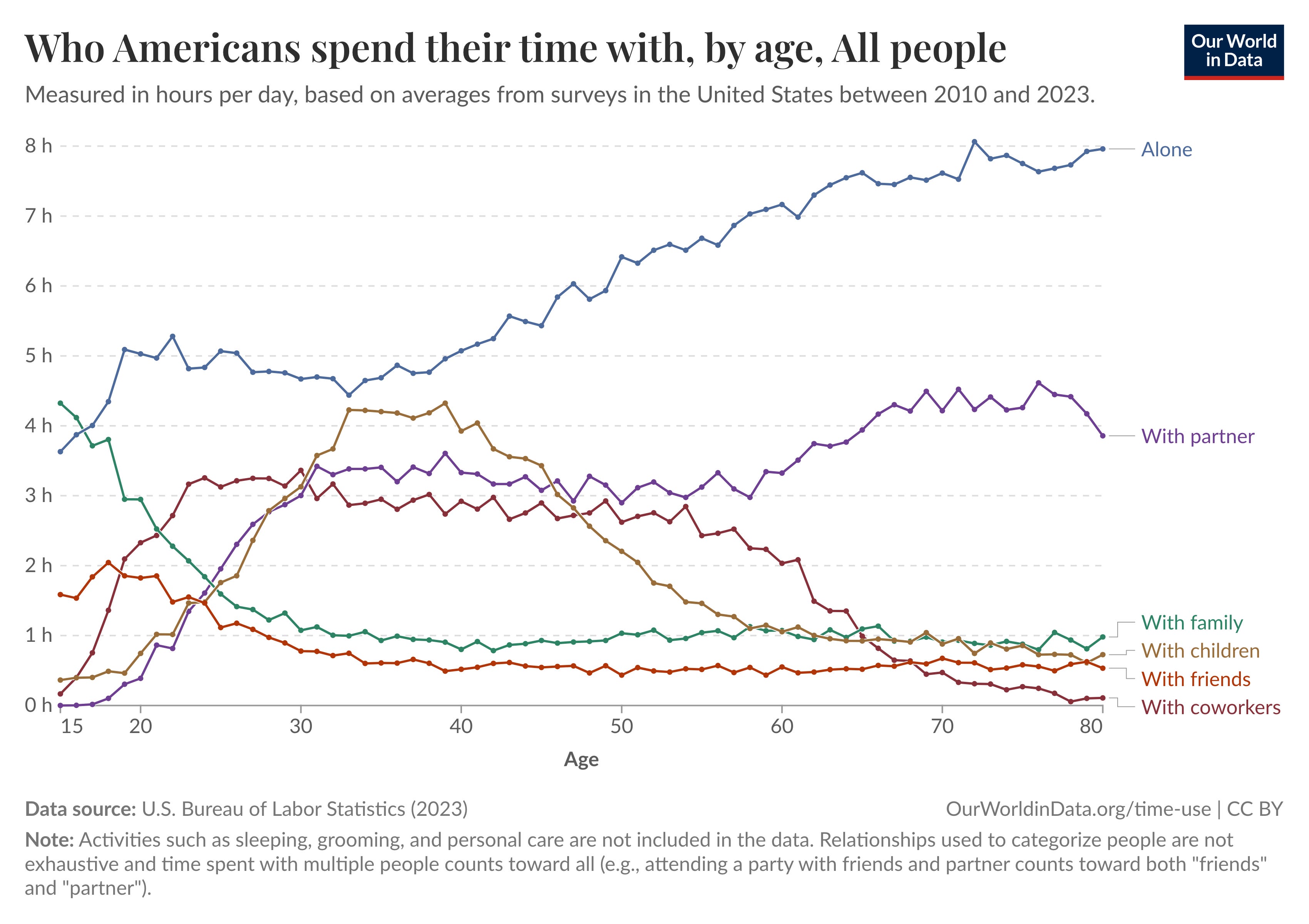
Is this wisdom or cowardice? After all, as we age, we become lonelier.
Who knows. I’m still young, and I have much to learn.
(I’m writing a book about taking total control of your life. It’s called CONTROL, and it’ll be ready in April.)
Based on the graphic we get lonelier over time but we also spend a lot of time with other people and I think that's an important point to notice, the time we spend with others becomes more valuable because it becomes more scarce over the years but doesn't this mean we can also love more easily the people we keep and who are still in our lives? so even if some people, friends, coworkers fade from our lives it's also easier to love the ones who remain, the ones who love you enough to subscribe to our joys and fears
Congratulations Freddy, I can't wait for the book!