

50% of all people fired from technology jobs lately are managers. Companies now expect managers to have 15 direct reports. In May 2026, Coinbase, GitLab, and Cisco announced nearly identical restructurings: kill the “pure manager,” flatten the org chart, reinvest in AI.
Cisco cut 4,000 jobs the same day it announced record revenues, with the CFO declaring: “This was really not a savings-driven restructure.”
Gallup measures manager engagement as the percentage of managers who care about their job and company. That number has collapsed from 31% to 22% in three years, while companies firing them have seen their stock prices rise.
If you’re a manager below layer two under the exec team, you should be paying attention. Not panicking. Paying attention.
Why managers, specifically
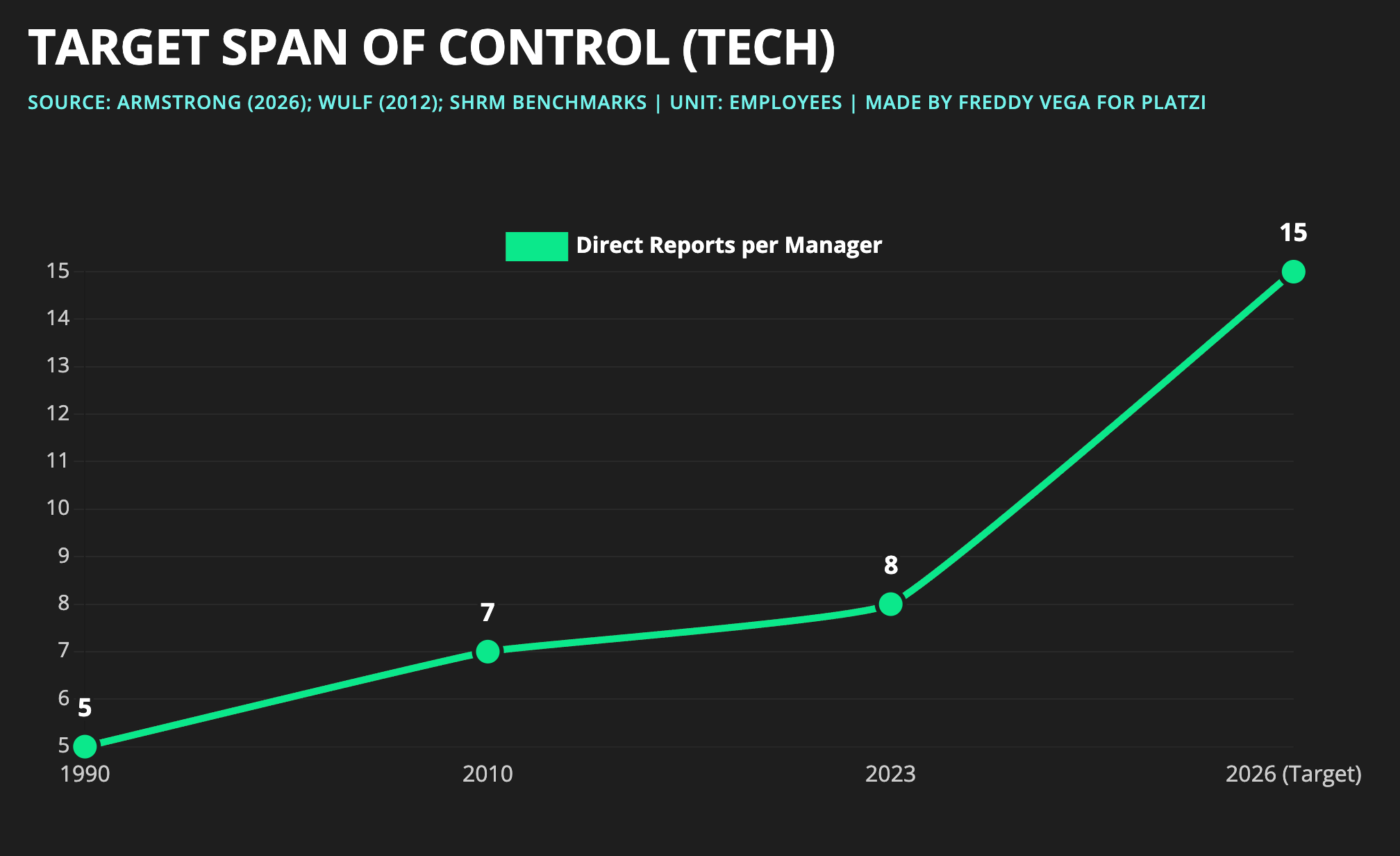
Direct reports per manager in the 90s averaged 5. By 2010 it was 7. By 2023, 8. The 2026 target is 15+.
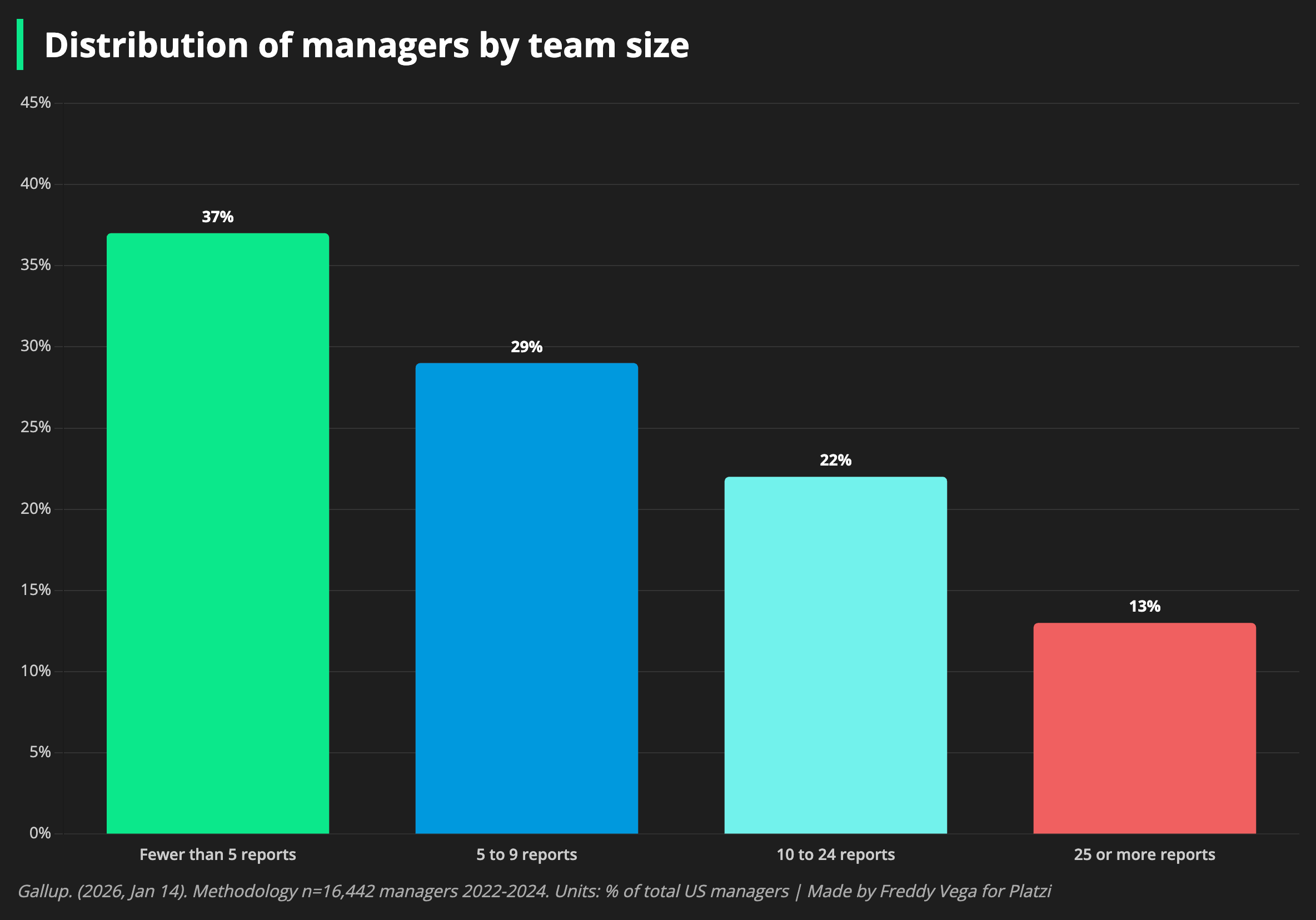
More than a third of managers manage four people or less. A lot of people want the manager title because that’s what their parents told them growth looks like, making it mostly cosmetic.
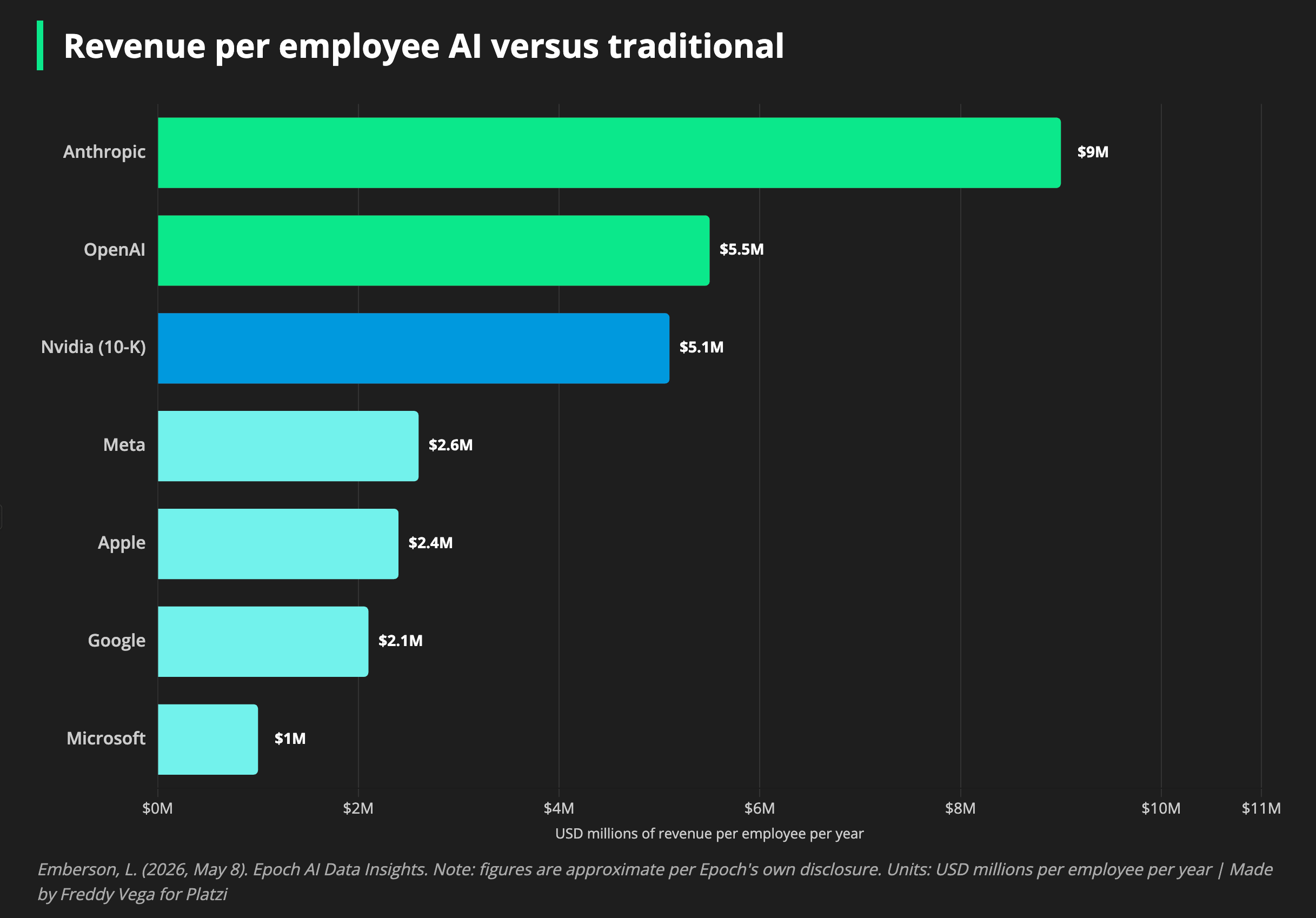
Meanwhile, the most efficient companies on the planet are running flatter than anything we’ve seen. Revenue per employee at Anthropic is around $9M. OpenAI $5.5M. Nvidia $5M. More money, fewer people, fewer layers.
The H.R. math
Communication channels grow by n(n-1)/2. A team of 3 has 3 channels. A team of 6 has 15. A team of 30 has 435. A team of 150 (roughly Platzi’s size today) has over 11,000.
This is from 1975 (Brooks, The Mythical Man-Month). Knowing this equation is part of what it actually means to lead people at scale. It’s the math behind talent.
Historically there was no fix for this. You hired more managers to route the communication. Middle managers are the human routing layer.
Then modern AI showed up. Claude for Work, Claude Code, Codex, agentic systems. Suddenly there’s a different way to absorb the routing tax.
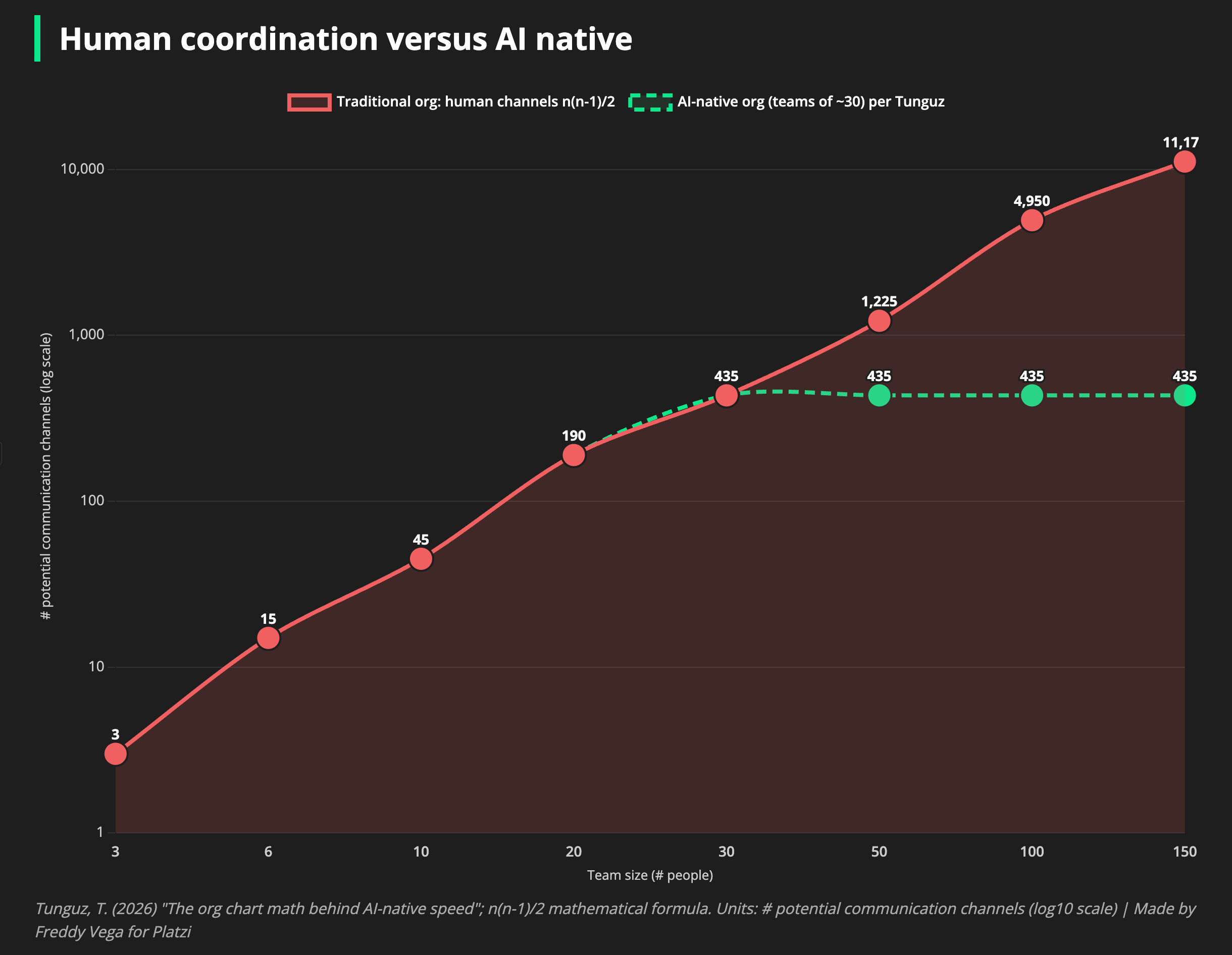
On a log scale, AI-native teams of 30+ can hold communication overhead roughly flat up to 150 people. The reduction is around 96% versus the human-only baseline.
Important caveat: “potential channels” isn’t the same as “real coordination cost.” Real companies route through hierarchy and tools. The math is a ceiling, not the actual level. But the direction is right, and the CEOs running the experiment seem to agree.
Where the manager’s time actually goes
McKinsey surveyed 700+ middle managers. 18% of their time is just moving data, filling forms, scheduling. 31% is individual contributor work that isn’t management at all. 28% is talent management. 23% is strategy.
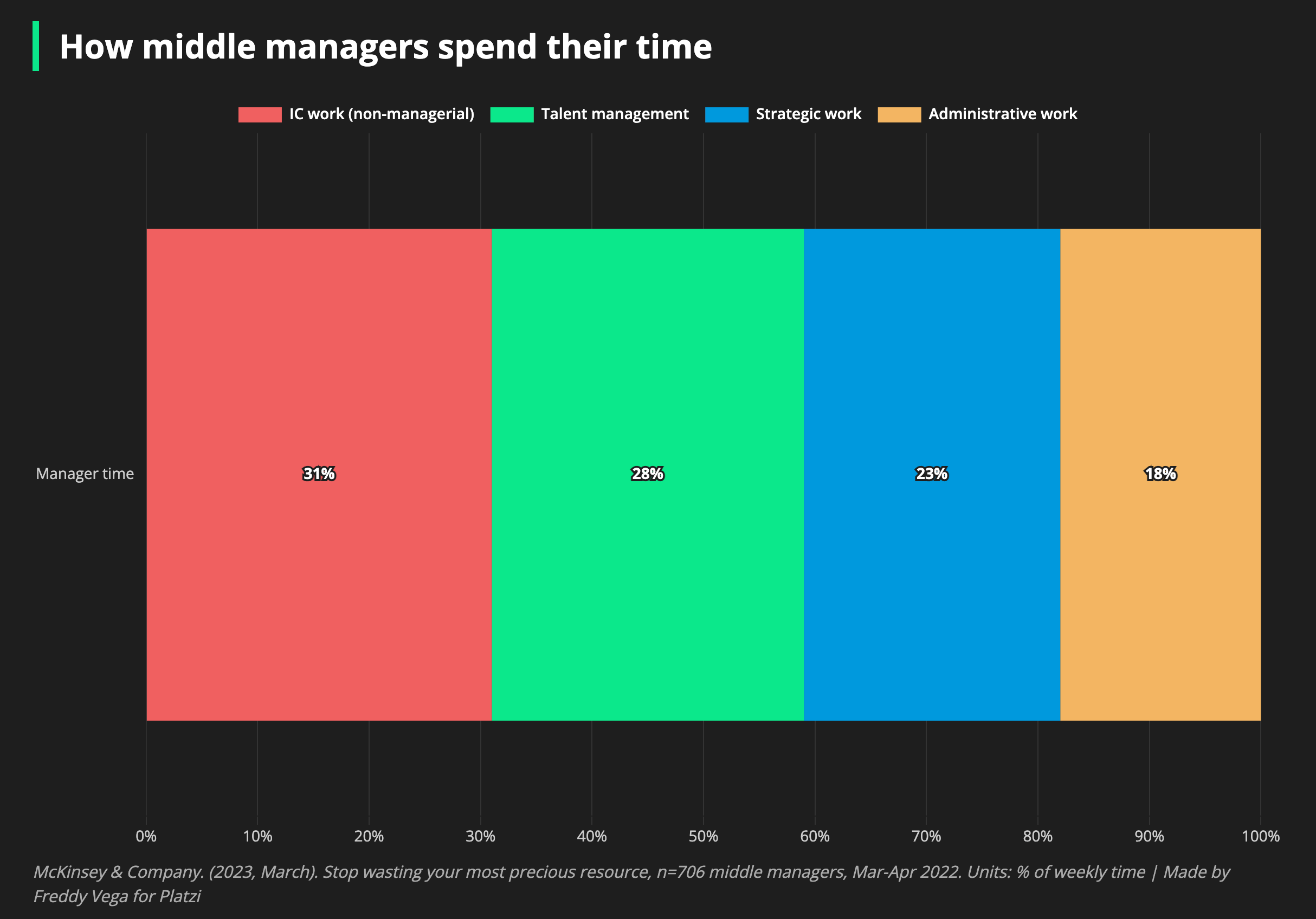
Roughly half the job is exactly what AI absorbs first. The other half is what survives.
In a flat AI-native org, a manager who learns can flip the ratio: 85% strategy and direct execution, 15% admin handled by agents. However, managers are the people slowest to update their technical skills.
This isn’t an insult. It’s structural. Managers built careers on a deal where every technical revolution could be delegated to a nerd. They built political capital, relationships across teams, and trust. That was enough for a whole career. AI is good enough that companies are realizing they don’t need that profile as much as before.
It doesn’t mean you, manager, are unnecessary. It means if you’re not learning, you are. Same lesson as always: never stop learning.
Managers actually don’t like being managers
After the pandemic came the Great Resignation. People stopped showing up. Coffee shops with no baristas, restaurants with no servers. What’s less talked about is who was leaving most. It wasn’t ICs. It was middle managers. People with the coordinator, lead, manager title who’d stopped feeling connected to the company.
Gallup measures this. The projection for 2026 is 18%.
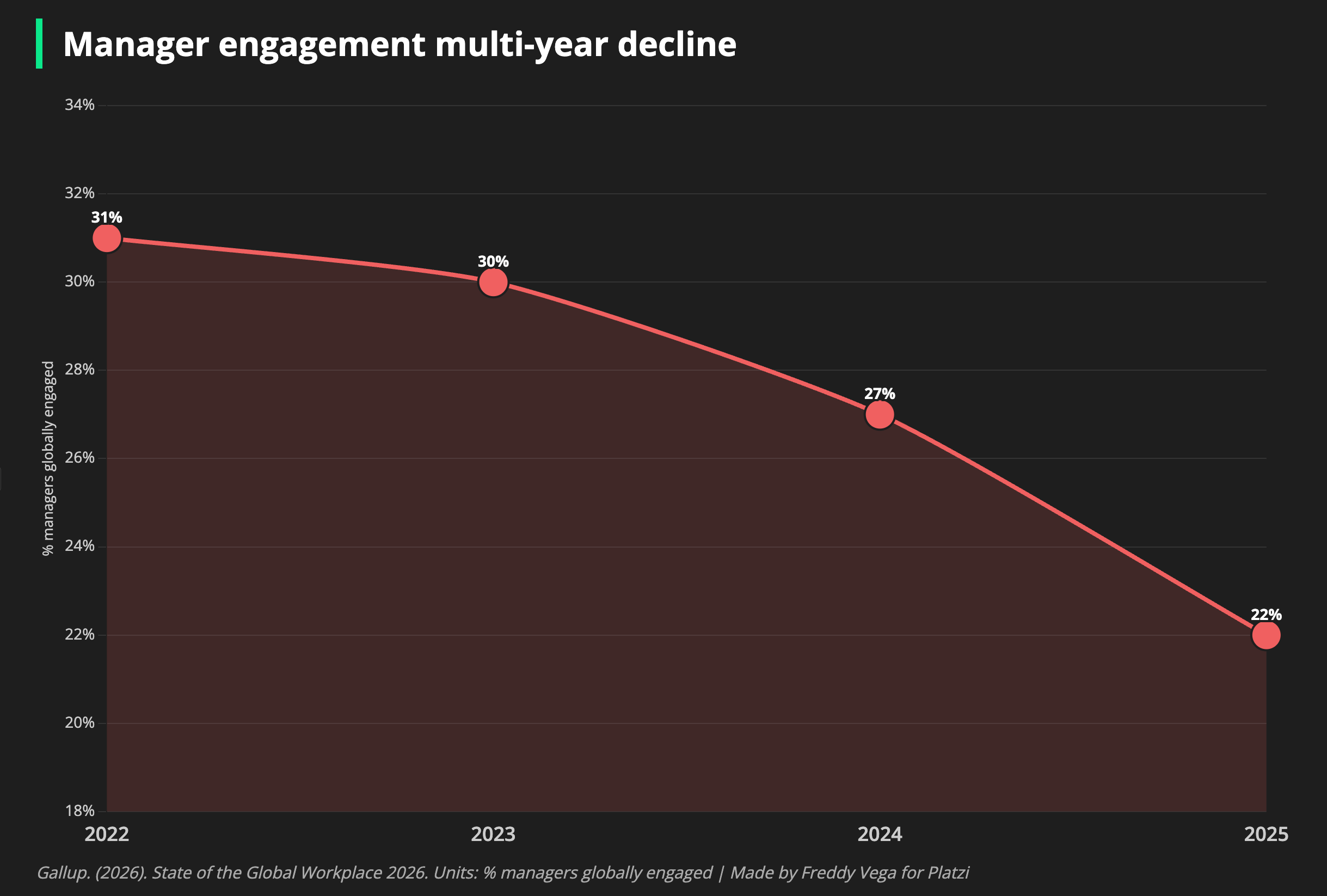
That’s a 9-point drop in three years, the biggest annual fall ever recorded in their study. For the first time, manager engagement is lower than IC engagement. Gallup estimates $438B in global productivity lost to it.
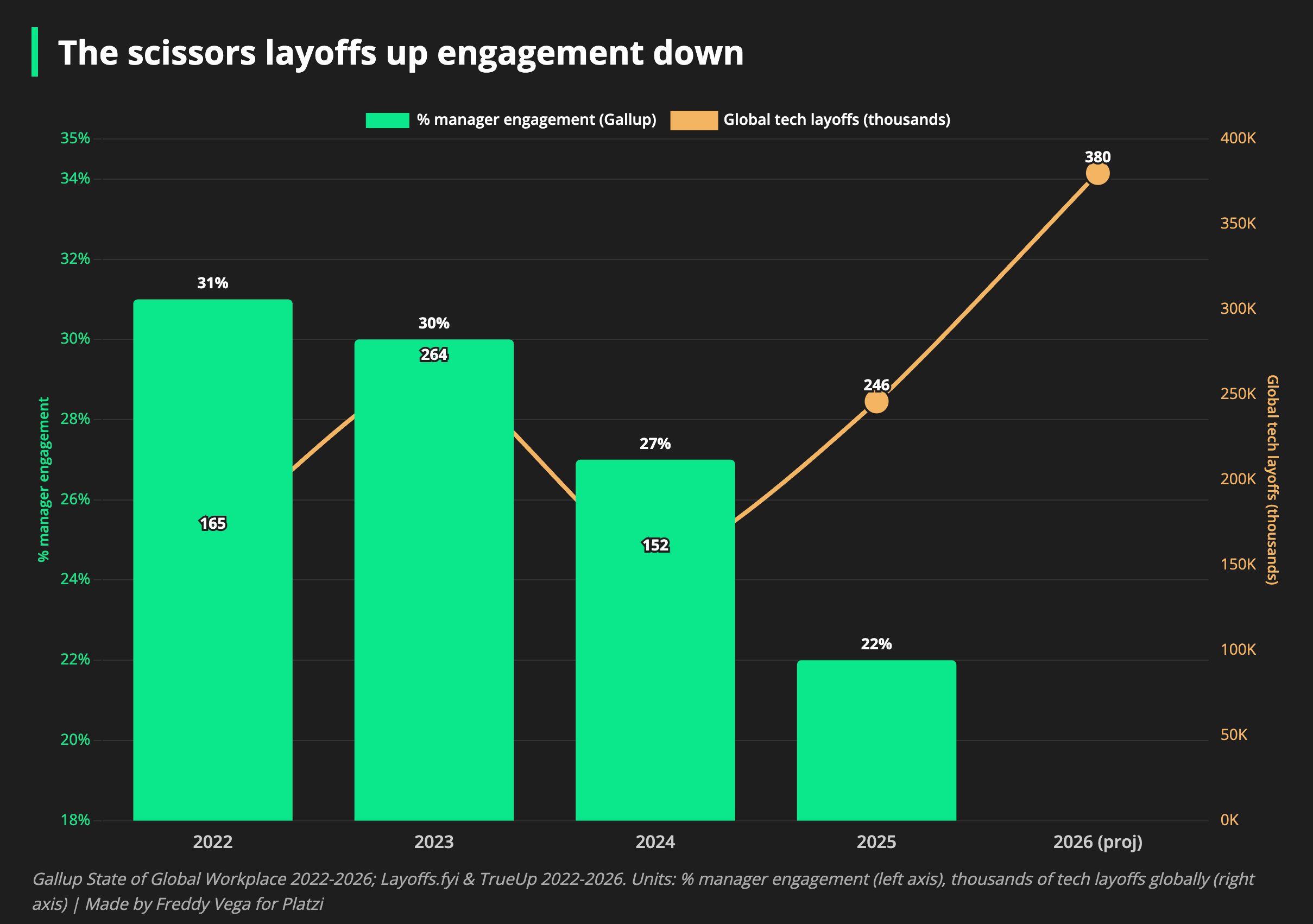
Now overlay that against tech layoffs and you get the chart that captures the whole thesis. Engagement falling, layoffs rising. The companies that survive are widening span of control on the managers who remain.
What’s actually replacing the manager
The player-coach: a technical lead who stays an IC 60-70% of the time and manages 15-20 reports. Harder. Pays worse emotionally. But it’s what big tech wants.
The agent orchestrator: where a manager used to direct 8 humans, an orchestrator directs 8 agents executing 80 tasks. New profession. Talent now has a cost-per-token.
The founder-mode CEO: the executive who skips layers, hires and fires personally, replaces the cultural glue middle managers used to provide.
So what do you do
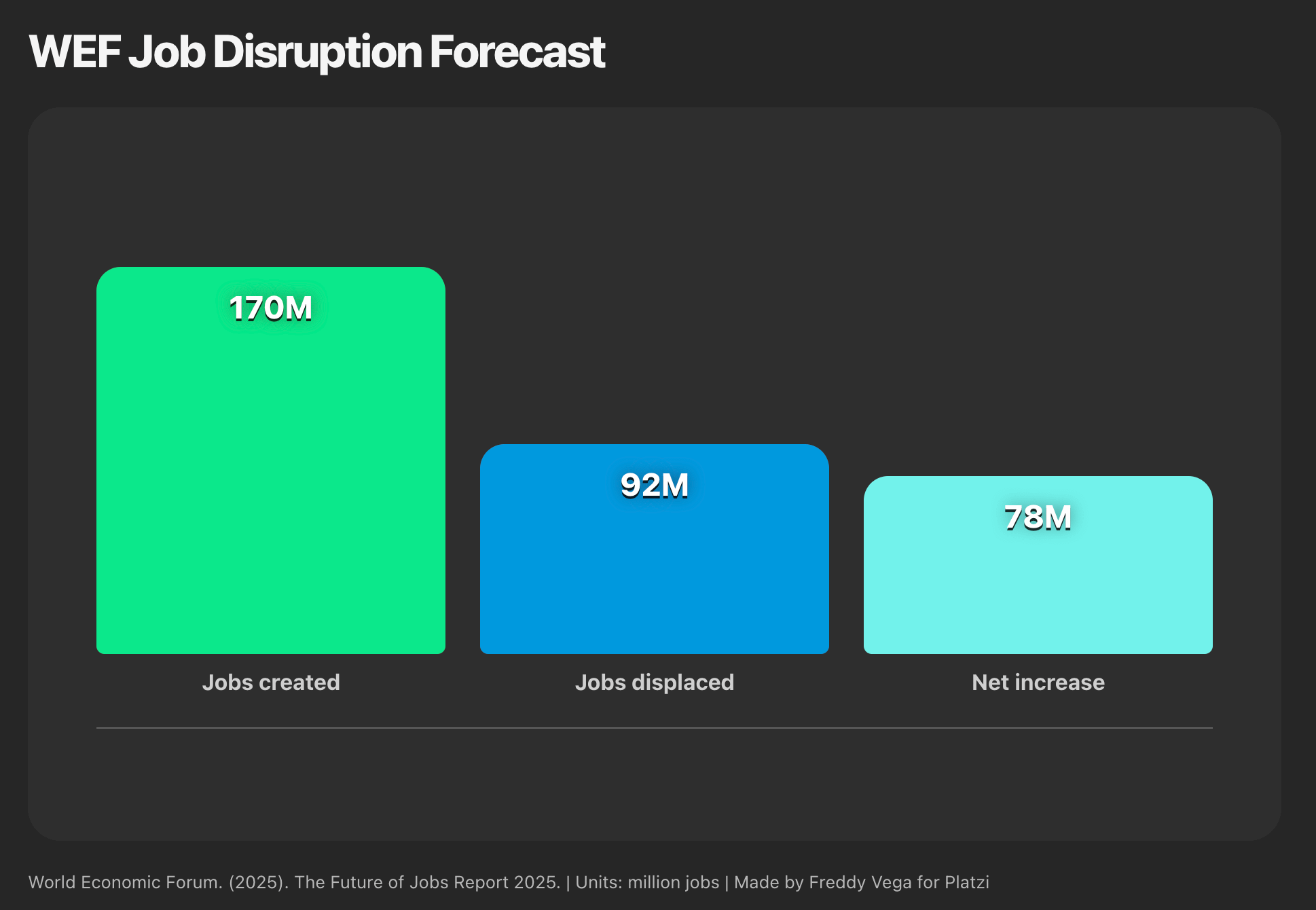
The World Economic Forum projects 170 million jobs created and 92 million displaced this decade. Net: 78 million more jobs than before. Disruption means different work, and more of it once the technology gets cheap enough.
My advice is boring and the same as always: start learning, now. If you lead a team, this isn’t a post to forward to your reports. This is one to act on yourself.
Look at this:
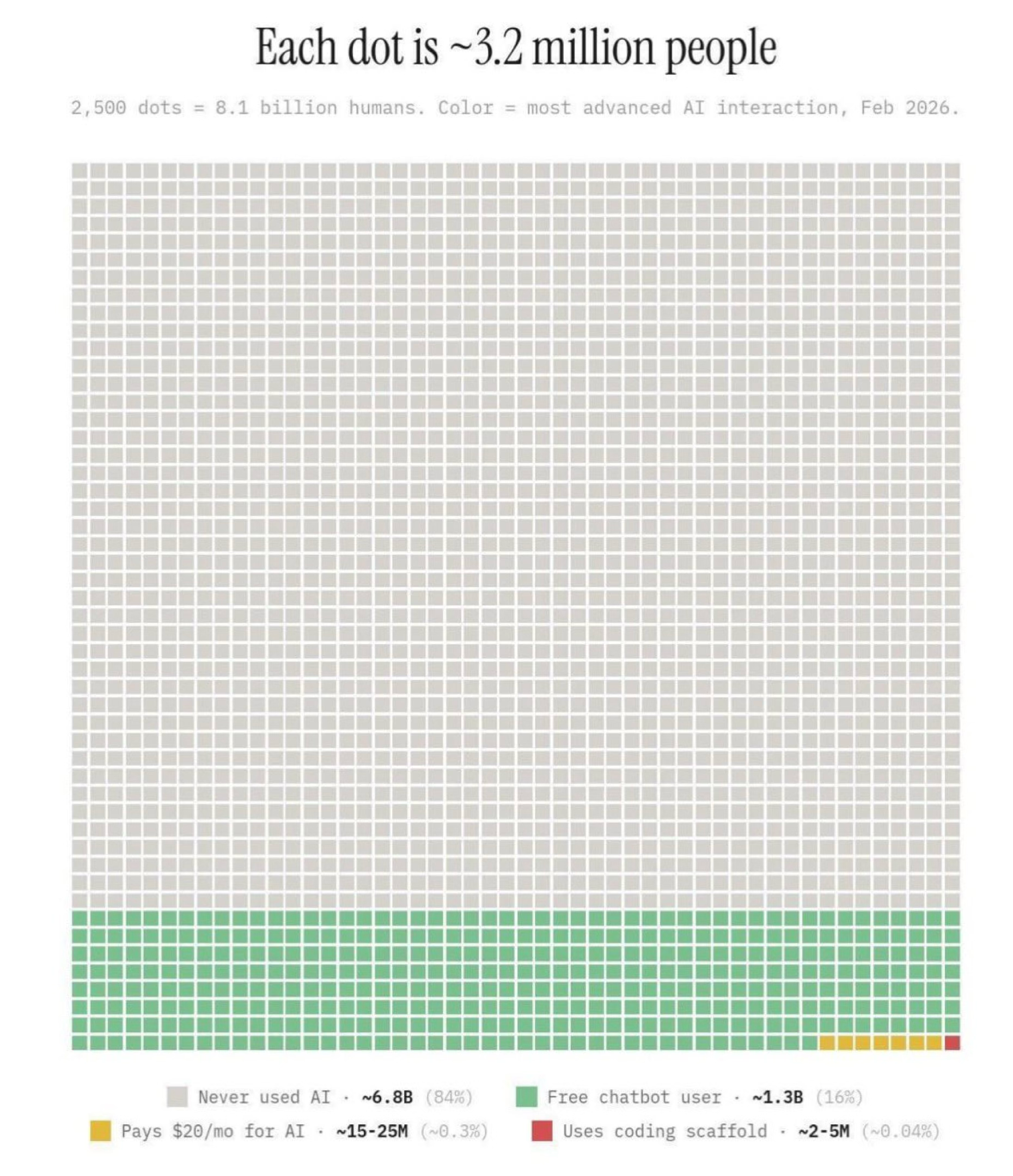
Every human alive, plotted by AI usage. Gray never tried it. Green uses the free tier. Yellow pays for a subscription. Red coded agentic systems that run autonomously. That tiny red dot is the frontier. The rest is an ocean.
This is barely starting.
https://www.error500.net/p/la-muerte-del-manager-ha-sido-anunciada
There is a lot in this article that feels quite spot on in terms of the pressure middle management is under right now. It is true that some of the traditional coordination work is being squeezed, especially as AI tools and more direct involvement from senior leaders change how information flows through organisations.
At the same time though, it highlights something really important about how much of management should actually be judgement, prioritisation and making sense of ambiguity rather than just passing things along. If anything, it feels less like managers are being removed entirely and more like the role is being reshaped and held to a higher bar around real impact and decision making.